
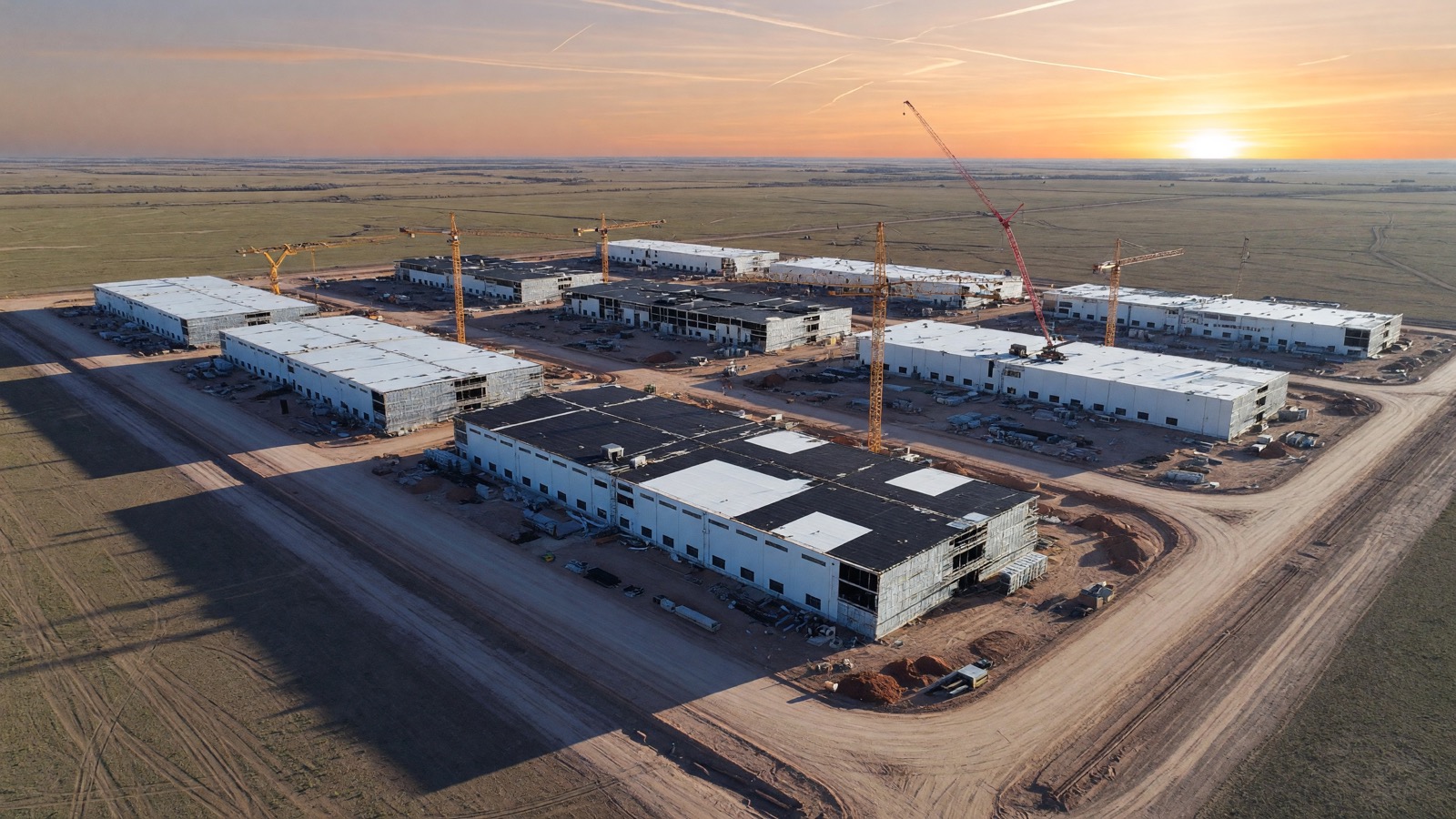
Somewhere north of Edmonton this week, crews broke ground on a building that will eventually draw as much electricity as 800,000 homes. Meta’s Sturgeon County campus is one project, in one province, for one company. Multiply it by everything else under construction and you get the largest infrastructure buildout the technology industry has ever attempted, and one of the largest any industry has attempted this century.
The term of art is the AI data center: a facility designed not for websites and email but for training and running AI models, packed with accelerator chips, engineered around extreme power density, and increasingly built with its own generation attached. Here is what the buildout actually looks like in numbers, what is confirmed versus forecast, and what it means if your business rents any of this capacity.
The scale, in verified numbers
The four largest spenders have all issued 2026 capital-expenditure guidance on earnings calls: Amazon around $200 billion, Microsoft around $190 billion, Alphabet in the $180 to 190 billion range after a mid-year raise, and Meta at $125 to 145 billion, also raised. That is roughly $700 billion in one year from four companies, most of it aimed at AI data centers, and it is guidance, not audited spending. No full-year actuals exist yet, and Amazon’s figure includes logistics infrastructure alongside AWS.
On the ground, BloombergNEF counted about 16 gigawatts of US data center capacity under construction as of late 2025, with mid-2026 broker estimates running higher, and roughly nine-tenths of that capacity already pre-committed to tenants before completion. Goldman Sachs projects US data centers will draw about 41 gigawatts of power in 2026, around 5.3 percent of peak summer demand, on a path to 8.5 percent by 2027. Every one of those power figures is a modeled forecast, and history says actual completions run behind announced schedules. And the buildout’s binding constraint is shifting from chips to inputs: memory and megawatts, not GPUs, now cap how fast capacity comes online.
How it gets paid for
The financing has become a story of its own, one we mapped in who is paying for the AI buildout. Corporate cash flow no longer covers it alone: Amazon sold $25 billion in bonds for AI infrastructure, Anthropic signed a $19 billion, 20-year lease for a Kentucky campus, and specialist developers like Crusoe and Nscale raise equity and credit lines measured in billions. Power is part of the capital stack too: Meta is funding a dedicated gas plant in Alberta, and Google has bought a stake in fusion as a longer-dated hedge. The pull of that spending now reaches beyond the hyperscalers: one Bitcoin-treasury company sold nearly half its stack at a loss to fund a Midwest AI data center.
What this means if you buy cloud or AI services
Three practical implications follow. First, capacity is being pre-sold years ahead, which is why AI compute pricing has stayed firm even as chip supply improved; if you are negotiating multi-year AI platform contracts, the underlying capacity market is a seller’s market into at least 2027. Second, location is becoming strategy: capacity is concentrating where power is cheap and permitting is fast, Alberta, Texas, the US Southeast, which affects data-residency planning for regulated buyers. Third, the delivery risk sits with timelines, not intent. Grid connections, transformers and permits are the binding constraints, so treat any vendor capacity promise dated past 2027 as a forecast, the same way the spenders themselves label their own numbers.
What to watch
Watch the gap between announced gigawatts and energized gigawatts, the single best indicator of whether the buildout is on schedule. And watch whether next earnings season’s guidance rises again: the spending numbers have only moved one direction so far, and the first hyperscaler to cut will tell the market more than any analyst report.
Frequently asked questions
How much are companies spending on AI data centers in 2026?
The four largest cloud companies, Amazon, Microsoft, Alphabet and Meta, have guided to roughly $700 billion in combined 2026 capital spending, most of it directed at AI data centers. These are company forecasts from earnings calls, not final audited figures.
How much power do AI data centers use?
Goldman Sachs projects US data centers will draw about 41 gigawatts in 2026, roughly 5.3 percent of peak summer demand, rising toward 8.5 percent by 2027. Individual AI campuses now reach 1 gigawatt, comparable to a nuclear reactor.
Who pays for AI data center construction?
A mix of corporate cash flow, debt and private credit. Amazon sold $25 billion in bonds for AI infrastructure, Meta funds dedicated power plants alongside its buildings, and specialist developers raise billions in equity and credit facilities.
Will the AI data center buildout slow down?
Constraints are already visible: grid connection queues, transformer shortages and permitting delays mean actual completions historically run below announced schedules. Spending guidance keeps rising, but delivery timelines are the number to watch.
AI and business tech news, verified by a physician who reads the filings. One email a week, no noise.