
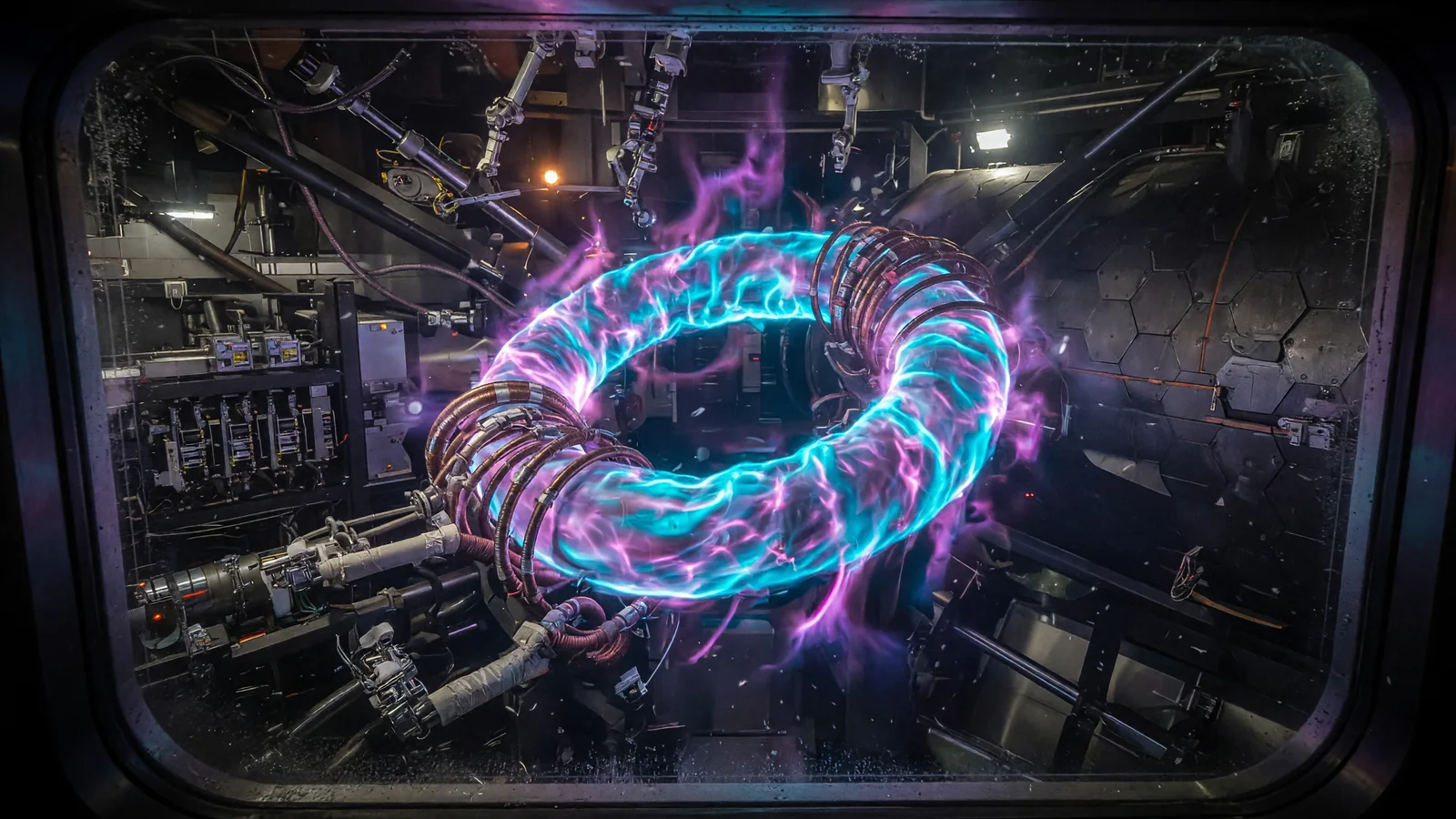
Google is now an investor in nuclear fusion. German startup Proxima Fusion announced a 411 million euro financing round at a 2.4 billion euro valuation, with Google and German utility RWE joining as strategic investors, Reuters reports. The round was led by XTX Ventures and East X Ventures; Google’s individual stake was not disclosed.
Proxima, spun out of the Max Planck Institute, is building stellarator-based fusion with the goal of Europe’s first commercial plant in the 2030s. For Google, the logic is not next quarter’s power bill. It is the recognition that AI’s appetite for electricity has no natural ceiling, and that every hyperscaler now needs a portfolio of energy bets stretching from solar to small modular reactors to, now, fusion.
Energy is the last bottleneck
The AI buildout’s constraints have moved in sequence: first GPUs, then memory, then land and grid connections. Power is the terminal constraint, the one you cannot manufacture more of by adding a fab. That is why the same week Amazon borrowed $25 billion for data centers, Google bought optionality on the physics that could eventually feed them. Fusion remains unproven at commercial scale, and 2030s timelines have slipped before; the size of the check tells you it is a hedge, not a plan of record.
Why a stellarator, and why Google pays for optionality
Proxima’s design choice matters to the investment logic. Stellarators, the twisted-coil alternative to the more common tokamak, historically traded engineering difficulty for a decisive operational advantage: steady-state plasma without the instabilities that plague pulsed designs. What changed is that the design work moved into software, modern computation can optimize coil geometries that were unbuildable when the concept was first abandoned, which is why a Max Planck spinout with access to the Wendelstein 7-X lineage can credibly promise commercial hardware on a venture timeline. An AI company funding fusion whose feasibility was unlocked by computation is a neat closed loop.
For Google the check is priced as optionality, and that is the right frame for reading hyperscaler energy portfolios generally. A few hundred million euros against a possible future in which firm, carbon-free baseload feeds data centers is cheap insurance when power is the binding constraint on the entire buildout. The portfolio logic runs from Meta’s dedicated gas plant in Alberta at the proven end to fusion at the speculative end, and the common thread is control: hyperscalers no longer trust the grid to deliver power on their timelines, so they are buying positions across every technology that might.
What to watch
Watch whether other hyperscalers follow with fusion stakes this year, whether Proxima hits its next hardware milestone on schedule, and how European regulators treat fusion licensing, the quiet variable that decides whether the 2030s target is credible. Meta took the more conventional route in Alberta, funding a dedicated natural-gas plant rather than betting on unproven physics, a hedge of a different kind.
AI and business tech news, verified by a physician who reads the filings. One email a week, no noise.