

Corewire pulled twelve months of US search-volume data to answer a simple question: has the way people think about AI actually shifted from chatbots to agents, or is “agentic” just industry vocabulary? The data says the shift is real, and the money agrees.
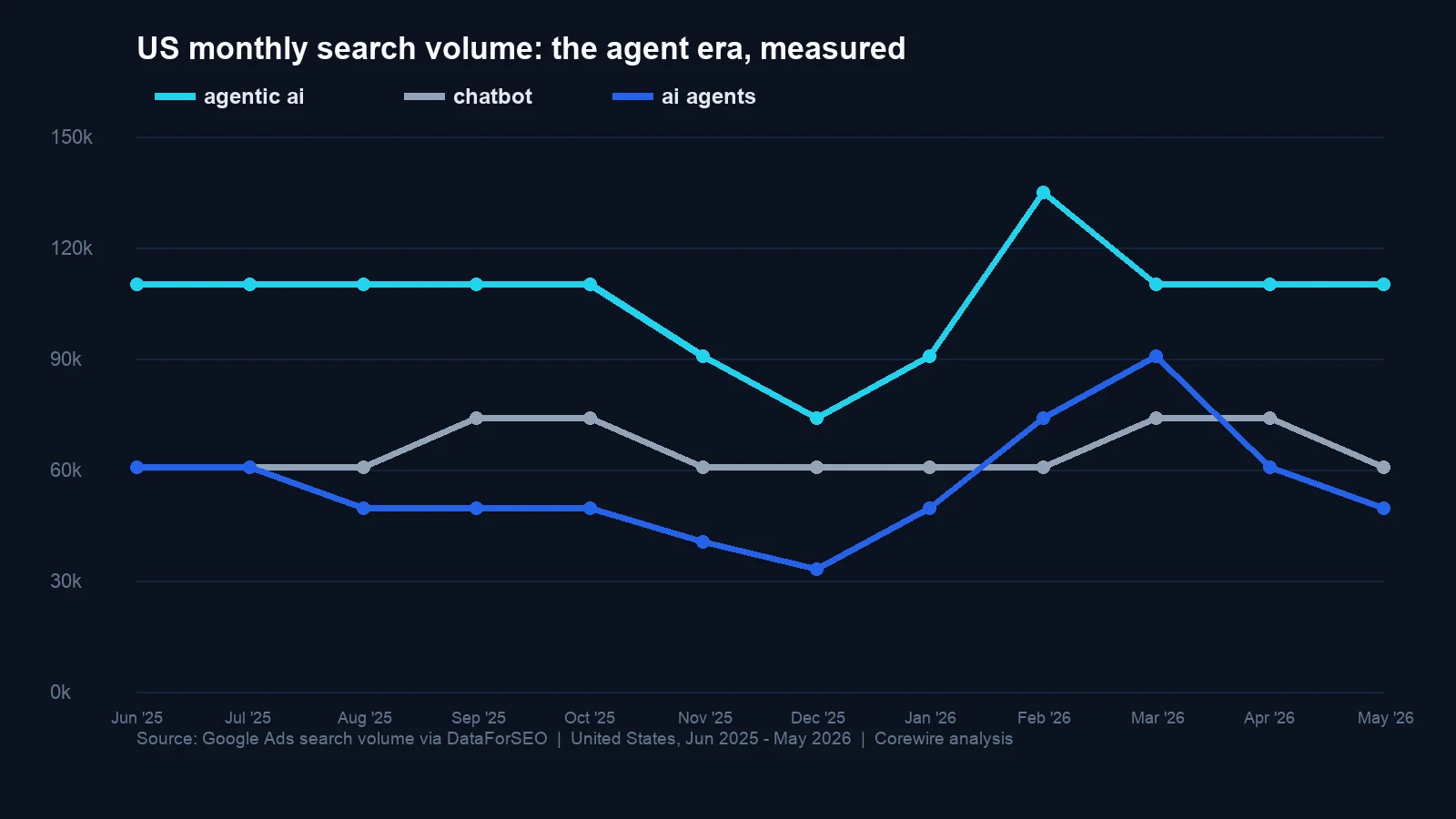
The headline finding: Americans now search “agentic ai” about 110,000 times a month, nearly double the roughly 60,500 monthly searches for “chatbot.” A term that barely existed two years ago has overtaken the word that defined consumer AI’s first act.
What the data shows
Three patterns stand out in the series. First, “agentic ai” holds a durable lead over both “chatbot” and “ai agents,” peaking at 135,000 searches in February. Second, “ai agents” is the fastest mover on momentum, more than doubling from its December low of 33,100 to a March peak of 90,500, the months when enterprise deployments began leaving the pilot phase. Third, “chatbot” is flat: steady between 60,500 and 74,000 all year, the search signature of a mature category.
The money signal is louder than the volume signal
Search prices reveal what the volume hides. Advertisers pay an average of $25.91 per click on “ai agents” and $15.18 on “agentic ai,” against $2.74 for “chatbot,” a nine-times intent premium that says the market believes agent searchers are buyers, not browsers. It is the demand-side echo of the acquisition war among model providers and consistent with where the real economics in AI software sit.
The single most expensive click in our basket was not an agent term at all: “ai medical scribe” carries a $54.36 average cost per click, double the agent premium. Advertisers price one clinician’s attention at more than fifty dollars, which is the market’s own verdict on the adoption wave we documented in our physician’s guide to AI scribes.
Why vocabulary shifts predict budget shifts
Search language is a leading indicator of procurement language. When buyers stop searching the category word and start searching the capability word, vendor positioning, analyst categories and RFP templates follow within quarters, and budgets follow the RFP templates. The chatbot-to-agent shift in search is the earliest public trace of a repricing that shows up later in contract terms and acquisition premiums. That is the practical reason to track a vocabulary race at all: the words are cheap, but they move ahead of the money.
Methodology and honest limits
Data: Google Ads monthly search volumes and average CPC, United States, June 2025 through May 2026, retrieved July 8, 2026 via DataForSEO. Google reports volumes in rounded buckets, so month-to-month moves within a bucket are invisible, and we excluded the term “ai assistant” from the headline chart because its series is event-driven and volatile (swinging from 49,500 to 550,000 within the year), which makes trend claims unreliable. This analysis is free to cite with a link to this page.
What to watch
If the vocabulary shift completes, expect “ai agents” to cross “chatbot” on volume within two quarters, and expect the CPC premium to compress as supply of agent-related content and ads catches up. We will rerun this analysis quarterly. The infrastructure investors are already positioning for that shift: a top private-equity firm just priced the web-data supply that AI agents run on at a $3.6 billion valuation.
AI and business tech news, verified by a physician who reads the filings. One email a week, no noise.