
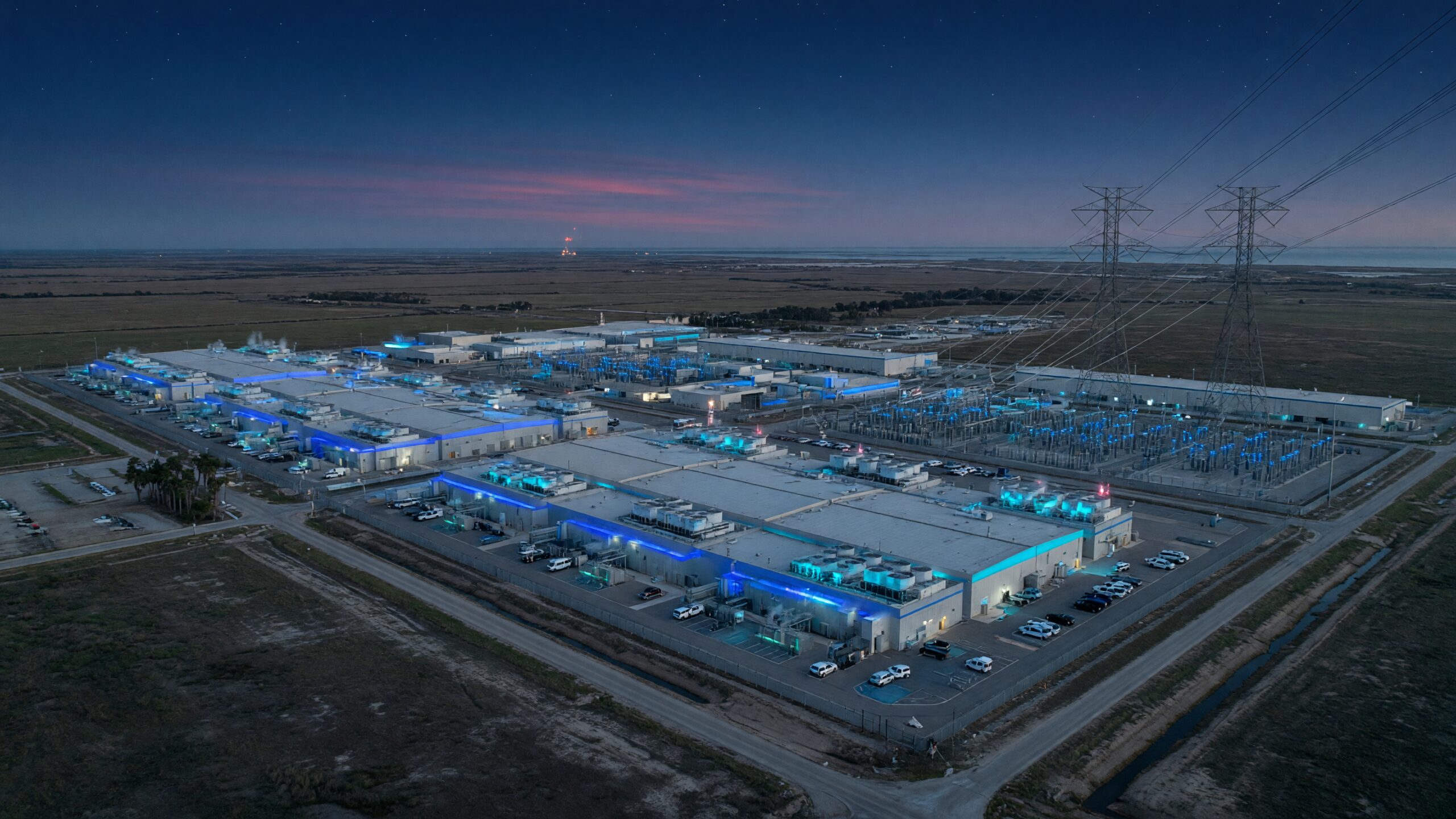
Hut 8 signed a second 15-year lease at its Beacon Point AI data center campus in Nueces County, Texas on July 20: another 352 megawatts of IT capacity worth $9.8 billion in base contract value, with a 3 percent annual escalator. The tenant, an unnamed investment-grade customer, doubled its footprint to 704 megawatts, and the deal fully commercializes the campus against its 1 gigawatt of secured utility interconnection with AEP Texas.
Campus-level contract value now totals $19.6 billion over 15 years, and up to roughly $50 billion if renewal options are exercised, per contemporaneous reporting. A former bitcoin miner just fully leased a gigawatt of AI capacity to a single tenant it will not name.
Why the structure matters
This is a landlord deal, not a cloud deal. Hut 8 develops the site, secures the power, and collects contracted rent for 15 years; the tenant brings its own compute. The template is the same one behind TeraWulf’s $19 billion, 20-year Anthropic lease in Kentucky: miners hold the two assets AI cannot wait for, grid interconnection and energized land, and long-dated leases to investment-grade tenants convert those assets into bond-like cash flows. Contrast that with Empery Digital selling bitcoin at a loss to fund its pivot: the miners who secured power early get rent; the ones who did not are selling coins.
How miners became the landlords of AI
The pivot looks sudden, but the asset behind it was assembled years ago. Bitcoin miners signed for large blocks of cheap power and grid interconnection back when nobody else wanted industrial-scale electricity in remote counties. Today, new interconnection requests can sit in utility queues for years, and that queue is the real moat: energized land with a substation attached is the one input in the AI buildout that cannot be bought quickly at any price. Converting a mining site to AI-grade infrastructure still takes serious capital for density and cooling, but the grid connection is the part money alone cannot accelerate.
Two business models are emerging from the same starting asset. IREN kept the compute risk, buying GPUs and selling cloud capacity, and just stacked $2.8 billion in contracts on that model. Hut 8 chose the landlord route: no GPUs, no cloud operations, just contracted rent from a tenant who brings its own compute. The rent model caps the upside well below what a cloud operator can earn per megawatt, but it also transfers technology risk, obsolescence risk and utilization risk to the tenant. Fifteen years of escalating rent from an investment-grade counterparty is a profile that looks more like a utility than a tech company, which is precisely what makes it financeable.
The signal
Fifteen-year commitments at this scale are the strongest form of demand evidence there is, stronger than capex guidance or funding rounds, because a tenant only signs one if it expects to need the power in 2041. Beacon Point joins Hyperion’s $50 billion repricing and the broader pattern in our data center boom explainer: the constraint is energized capacity, and whoever holds it is setting terms. The tenant’s anonymity is itself a tell. In a market this tight, even the identity of who locked up a gigawatt is competitive information.
AI and business tech news, verified by a physician who reads the filings. One email a week, no noise.