
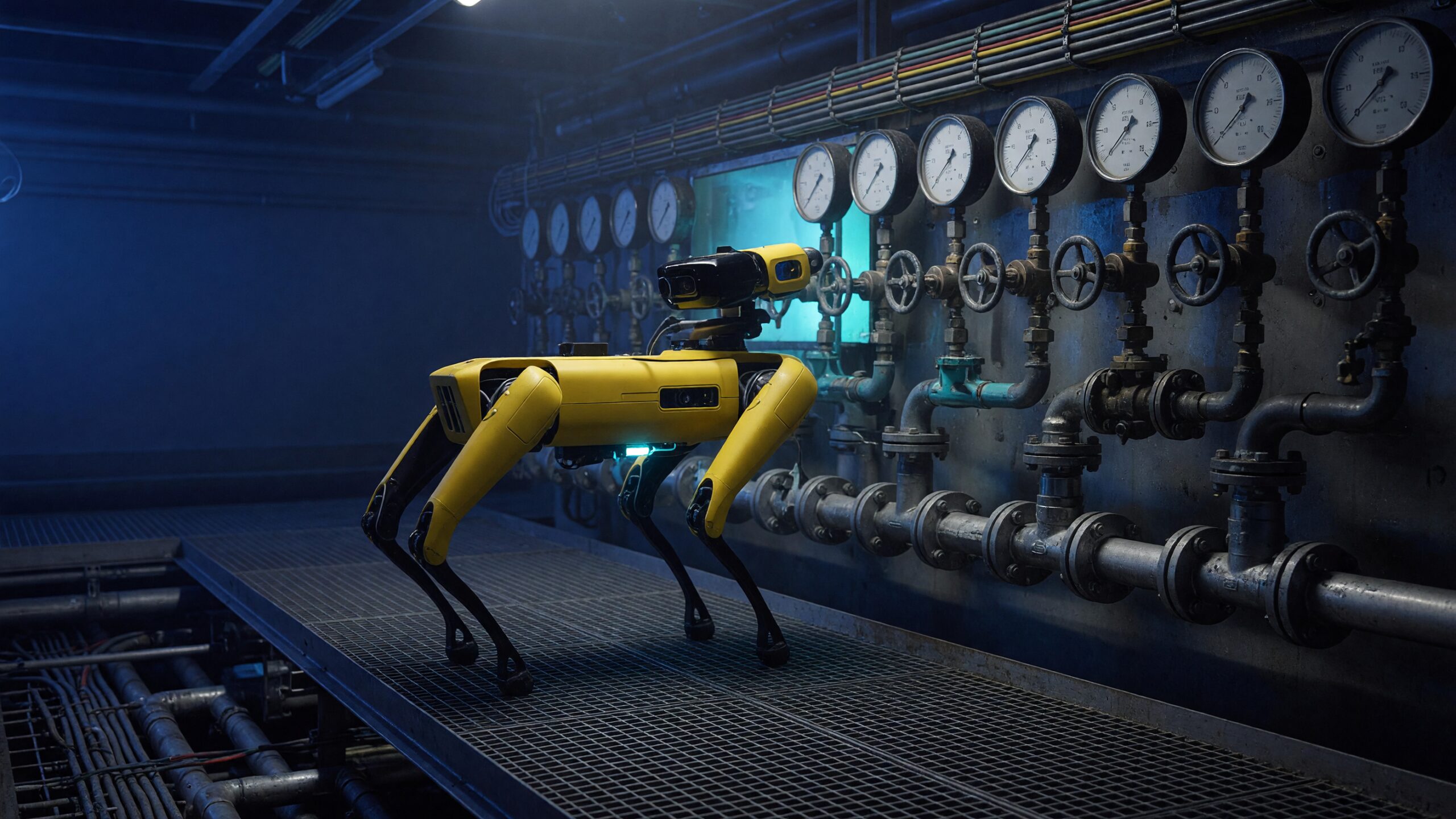
Boston Dynamics has put a Google DeepMind reasoning model to work inside its Spot robot dog. As of April 8, 2026, every customer on the company’s Orbit “AIVI-Learning” tier runs on Gemini Robotics-ER 1.6, the embodied-reasoning model Google DeepMind shipped to developers on April 14. This is not a staged lab demo: it is a live, generally available capability for paying inspection customers.
The practical upshot is that Spot no longer just walks a fixed route and matches what it sees against a pre-trained template. It can read an analog gauge it has never encountered, judge how full a sight glass is on a 0 to 100 scale, count pallets, flag a puddle of standing liquid, and then explain in plain language why it raised the alarm. Foundation models spent 2024 and 2025 living on screens. This is one of them moving into a machine that walks.
What is actually new
Spot has been doing autonomous industrial inspection for years. Orbit is Boston Dynamics’ fleet software, and AIVI-Learning is its inspection-intelligence layer. What changed in April is the brain behind that layer. Boston Dynamics, working with Google Cloud and Google DeepMind, swapped its narrower trained models for Gemini Robotics-ER 1.6, a general reasoning model that understands 3D space, reads instruments, and decides when a task is actually complete.
The architecture matters here, and the marketing tends to blur it. The reasoning runs in the cloud, not on a chip bolted to the dog. Google DeepMind describes ER 1.6 as a high-level model that plans, reasons about a scene, and calls tools like vision-language-action models when it needs finer control, rather than an onboard controller driving Spot’s legs in real time. Boston Dynamics leans on that split to promise “zero-downtime” upgrades: the model improves in Google’s cloud and every Spot on AIVI-Learning inherits the gains without a site visit or a firmware push.
The numbers
Google DeepMind’s headline metric is instrument reading, the unglamorous but genuinely hard task of interpreting a rusty analog dial or a half-lit digital readout. ER 1.6 hits 93% success when its “agentic vision” is switched on, meaning the model can zoom in and run code to check its own reading, versus 86% without. On safety, DeepMind reports the model identifies injury risks 6% more accurately than Gemini 3.0 Flash in text scenarios and 10% more accurately in video.
The model reached developers on April 14 through the Gemini API and Google AI Studio, so the Boston Dynamics deployment is the flagship reference case for a model anyone can now build against. That is the deal on both sides: Google gets a marquee industrial robot running its physical-AI stack, and Boston Dynamics gets to outsource the hardest perception problems to a model that improves on Google’s schedule, not its own.
The signal
The real story is not one smarter robot dog. It is the emerging shape of embodied AI: a general foundation model does the thinking, and the robot is reduced to a body that moves and senses. That division of labor is exactly what makes it scalable. The same reasoning layer that reads a gauge for Spot can, in principle, read one for any robot wired to the Gemini API. This is the pattern to watch as the frontier shifts from chatbots to hardware, and it is why the physical-AI race now runs through the same handful of model providers, a dynamic already visible in China’s vertically integrated AI-and-robotics stack.
What to watch
Three caveats keep this in proportion. First, the intelligence is rented. Spot’s new judgment lives in Google’s cloud, which means connectivity, latency, and vendor dependence are now part of the safety story. A robot whose reasoning sits behind an API is a robot exposed to the same foundation-model lock-in that enterprises are already wrestling with in software, only now the stakes include a physical machine in a hazardous facility.
Second, a benchmark is not a refinery. A 93% instrument-reading score on a curated test set is not 93% on every corroded gauge in bad light, and the 7% it misses are safety-critical reads by definition. Boston Dynamics is careful to frame this as assistance for human inspectors, not a replacement, and that framing is doing real work. Third, running vision-language reasoning at industrial cadence is not free: sustained embodied inference is precisely the workload driving the inference-silicon race, and the cloud bill scales with every robot and every mission. This is a concrete, shipping capability, not a concept video. It is also a narrow one, inspection, and the gap between reading a gauge and general dexterity remains very wide.
AI and business tech news, verified by a physician who reads the filings. One email a week, no noise.