
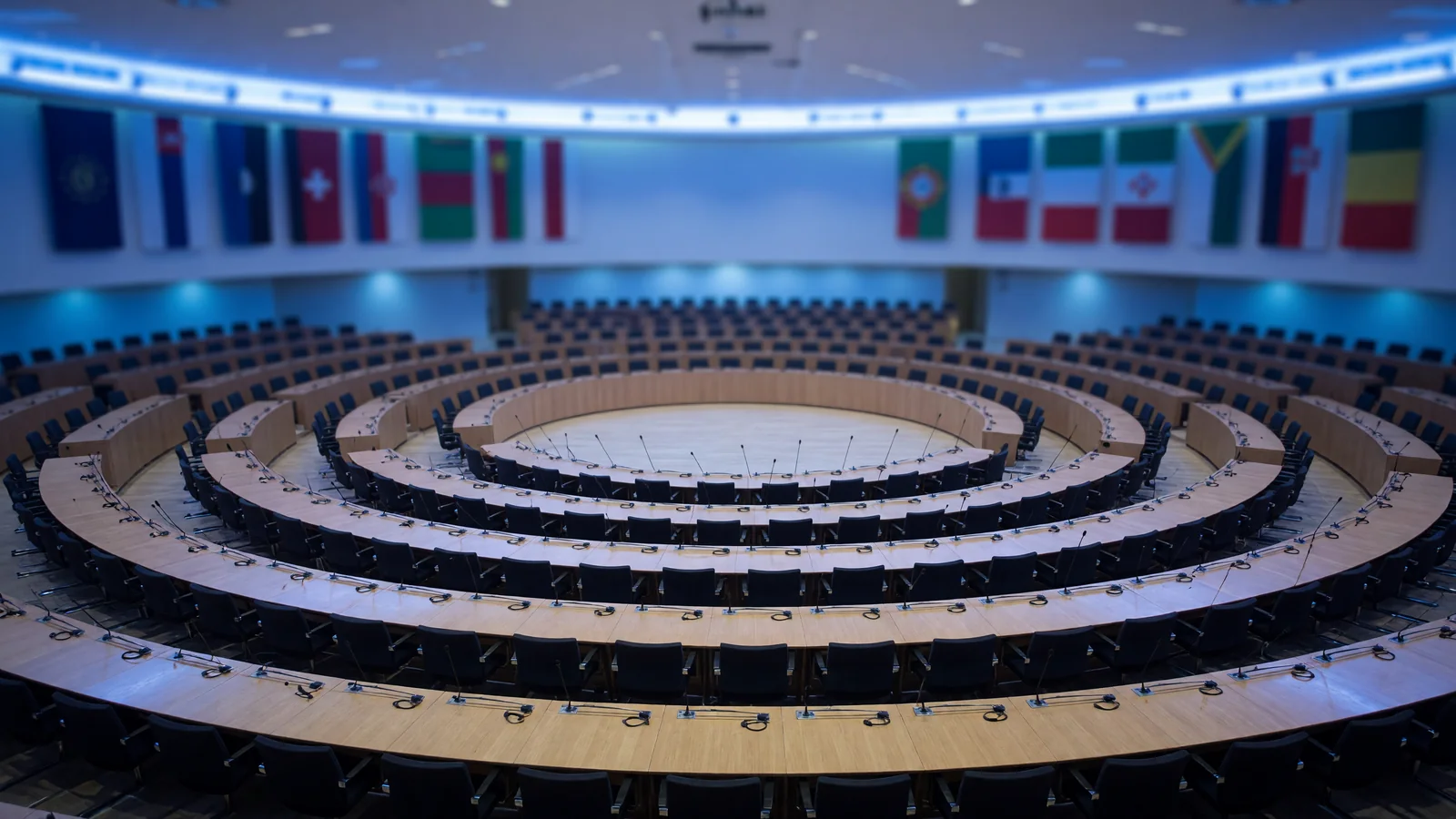
The people who build AI now sit inside the body meant to govern it. The UN’s AI for Good Global Commission, launched last week, held its first meeting today in Geneva: a 44-member body co-chaired by Rwandan President Paul Kagame and Salesforce CEO Marc Benioff, with ITU Secretary-General Doreen Bogdan-Martin as vice-chair, per the founding announcement and Axios’s reporting.
The membership is the story. Alongside heads of state sit Nvidia’s Jensen Huang, Amazon’s Andy Jassy, Microsoft’s Brad Smith, Anthropic co-founder Jack Clark and Cohere’s Aidan Gomez. The commission’s stated first priority is the digital divide: 2.2 billion people remain offline.
What a commission like this can and cannot do
It has no regulatory power. What it has is convening power, the ability to set shared vocabulary and reference standards that national regulators later borrow, which is how ITU processes have shaped telecom policy for a century. For enterprises, that makes Geneva worth watching not for rules but for signals: the definitions of “safe deployment” and “meaningful access” drafted here tend to reappear in procurement requirements years later.
The obvious critique arrived on day one: a governance body seating the industry’s biggest commercial interests will struggle to police them. The counterargument is that no body excluding them has managed to matter. Both things can be true, and probably are.
The governance vacuum this fills
The commission exists because the binding alternatives keep stalling. The EU’s AI Act stands largely alone as enforced law, US federal legislation remains stalled behind partisan disagreement, and the UN’s own prior efforts produced advisory reports with no machinery behind them. Into that vacuum, a convening body with industry inside it is not competing against strong global governance, it is competing against nothing. That is the most generous reading of why Kagame and Benioff’s roster looks the way it does: the choice was never between this commission and a tougher one.
History offers both versions of how industry-seated bodies age. Telecom standards through the ITU and the internet’s own governance bodies show insiders producing durable, useful coordination when incentives align. Financial-industry self-regulation before 2008 shows the other outcome: vocabulary and process that looked like oversight while the incentives ran the other way. Which trajectory this commission follows will show up early in small things, whether its published definitions get cited by national regulators, and whether members accept framings that cost them anything. The absence of OpenAI and Google from the founding roster is the tell to keep watching: a governance table that the two most consequential players can skip without penalty is measuring its own convening power in real time.
What to watch
Watch what the commission publishes after this week’s summit, whether OpenAI and Google, notably absent from the founding member list, join later, and whether the digital-divide framing survives contact with the members’ competing agendas.
AI and business tech news, verified by a physician who reads the filings. One email a week, no noise.