
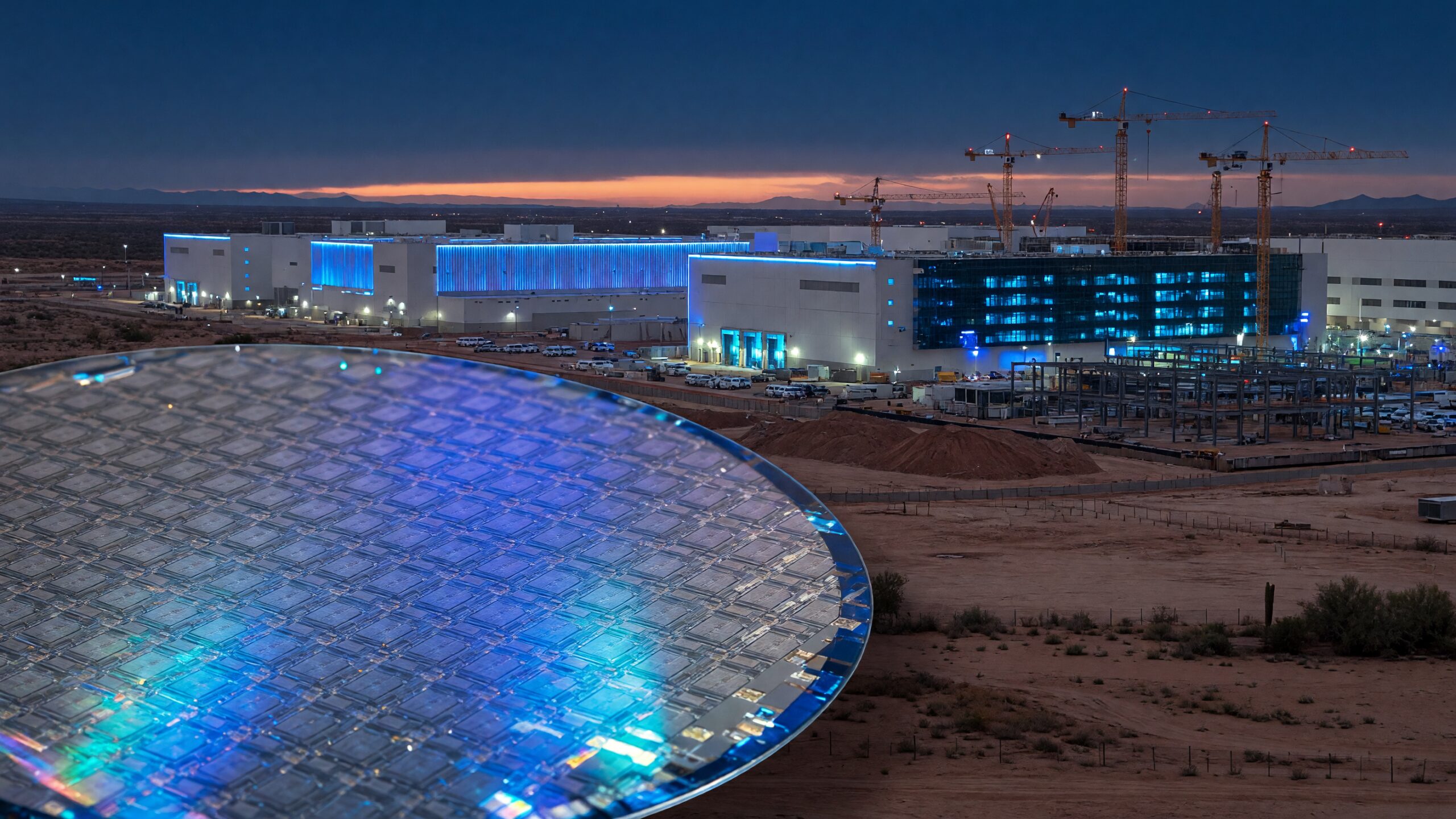
TSMC’s July 16 earnings call turned a record quarter into a statement of intent. Net income came in at NT$706.56 billion on the NT$1.27 trillion in revenue the company had already pre-announced, with gross margin at 67.7 percent, per the earnings release. Then came the guidance: 2026 capital expenditure raised to $60 to $64 billion from $52 to $56 billion, full-year revenue growth lifted to slightly above 40 percent, and an additional $100 billion committed to Arizona.
The foundry that fabricates nearly every AI chip on earth just told investors that demand is structural, multi-year, and worth betting another $100 billion of American concrete on. Total US commitment now stands at $265 billion.
The numbers under the guidance
We covered the revenue side when the monthly figures landed: a record $39.6 billion quarter as the cleanest read on AI demand. The call filled in the profitability: net income up 77.4 percent year over year, an operating margin of 60.3 percent, and Q3 guidance of $44.6 to $45.8 billion, which would be another record. Capex allocation stays weighted 70 to 80 percent toward advanced process technologies, with 10 to 20 percent for advanced packaging, the choke point every AI accelerator queues through.
$100 billion more for Arizona
The new Arizona money funds several more logic fabs at 2 nanometers and below plus advanced packaging facilities, per the call transcript, explicitly to serve leading US customers with government support at federal, state and local level. Advanced packaging on US soil matters as much as the fabs: it is the difference between chips made in America and AI systems built in America.
The bear case TSMC is daring
Semiconductors are the most cyclical industry in technology, and every capex supercycle in its history has ended the same way: capacity arrives after demand has already rolled over, utilization gaps open, and margins compress. TSMC’s management knows that history better than anyone, which is what makes a guidance raise of this size the interesting signal. The company is effectively daring the cycle, and its defense is the order book: capacity at the leading edge is committed by customers years in advance, which pushes much of the demand risk onto the chip designers rather than the foundry.
The counterargument got a live test the same week, when the Kimi K3 selloff priced the fear that efficient open models shrink compute demand. TSMC’s guidance embodies the opposite thesis: cheaper intelligence gets used more, not less, and every efficiency gain to date has expanded total silicon consumption rather than reduced it. There are real costs to being wrong. Overseas fabs run structurally more expensive than Taiwan, so Arizona capacity leans harder on sustained demand to earn its keep, and the constraints we mapped in memory and megawatts mean even perfect fab execution depends on power and packaging keeping pace. The company with the industry’s best demand visibility just made its largest-ever bet that the cycle is different this time. That is either the strongest evidence available, or the top.
The signal
Every layer of the supply chain is now confirming the same trade. Samsung guided to a record quarter on AI memory, SK Hynix raised $26.5 billion on Nasdaq, and Dell’s server backlog hit $51 billion. A capex raise of this size from the industry’s most conservative forecaster is the opposite of the caution the Kimi K3 selloff priced in days later: TSMC sees demand through 2030 and is pouring foundations for it. One of these two market reads is wrong, and TSMC has the order book.
AI and business tech news, verified by a physician who reads the filings. One email a week, no noise.